Khaled Hosseini's A thousand splendid Suns
Posted On Tuesday, November 04, 2008 at at 11:22 by rk rishikesh sinhaBy Pranati Saikia

'My Name Is Red'
Posted On Monday, September 22, 2008 at at 18:07 by rk rishikesh sinhaBy Pranati Saikia, New Delhi
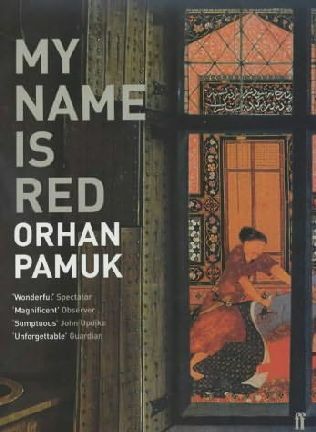 To read Pamuk is to delve deep inside many serious things, to sway between fact and fiction, to gain insight and feel more prudent just like a scholar. After reading 'My Name Is Red' one of the brilliant novels by this hardheaded intellectual, I felt exactly the same, witty and wise. The novel takes you to an exotic tour of the realm of art and discusses many important facts of the Islamic Literature. While reading the novel, you will have the feeling of being shifted to sixteenth century Istanbul, Exploring the Ottoman society, its way of life and witnessing its cultural past.
Basically a murder mystery, yet 'My Name Is Red' has however surpasses the conventional limits of the kind. The novel is an excellent blending of fact and fiction. The narratives of all the chapters are long philosophical discussions on the nature of art, the essence of 'Style', relationship between God and the artist, and profound psychological analysis of human emotions of Love, Guilt and Sin.
Pamuk has used wonderful theatrical style in the novel and dexterously presented the story through a series of dramatic monologues. Each character has unraveled different stories to form the conceivable scenarios tangled with confusion and ambiguity. Every character has been given voice, even the picture of a Tree, a Dog, a Horse and a gold coin to put forward opinions, which has made the story more interesting and appealing.
The story is set in the Ottoman Istanbul and the year is 1591. Ulema and the Ottoman traditionalists are agitating against the art of painting, especially in the 'European Style'. Traditionally the whole concept of representational art is regarded with great suspicion in Islam. It is given in the glorious Koran that 'creator' is one of the traits of God. It is Allah who is creative. It is He who brings that which is not into existence. He gives life to the lifeless. No one ought to compete with Him. The painters who claim to be as creative as Him are committing greatest of sins.
The main characters of the story belong to the Sultan's workshop. The artists of this workshop have passed their lifetime listening to stories in coffeehouses and studying the work of the great Islamic masters whose illustrations embellish the Persian mythology. They have spent years illuminating old stories with new pictures by following the methods of the old masters and operating on the strict guidelines set by imams who interpret the Koran as tolerating visual art only as an extension of writing.
Now a group of miniaturists have been hired by the master Enishte Effendi to work on a secret manuscript in the ' European Style' who has been commended by the Sultan. One of these miniaturists has been killed mysteriously and dumped in a well. Meanwhile, Black, the hero of the story has returned back to his native land Istanbul after an absence of twelve years. He has been summoned back by his master and maternal Uncle Enishte Effendi. All these years Black had been traveling into far-flung areas of Persia and working as a secretary in the service of the pashas. During these years he was also trying to visualize the vision of his beloved, Shekure, the daughter of Enishte Effendi with whom he fell in love desperately twelve years ago but her hand his Enishte had denied him.
Shekure is ravishingly beautiful yet devious woman and a mother of two young sons, Shevket and Orhan. After his arrival, Black learnt that Shekure has been recently widowed. He also discovered that one of his Enishte's illustrators has been murdered secretively. In his meeting with Enishte, Black has been told that the Sultan has commanded Enishte to complete a special illustrated book. “Our Sultan, refuge of the World, wanted to demonstrate that in the thousandth year of the Muslim calendar He and His state could utilize the styles of the Franks as well as the Franks themselves". So Enishte has been asked to conquer the west by imitating its culture.
But in the eyes of Nusrat Hoja (a cleric at the Bayazid Mosque) and his fundamentalist followers, imitating west will be blasphemy against Allah, against the East. During his meeting with Enishte, Black also met Shekure's youngest son and soon a feeling of restlessness has aroused in him to meet his beloved.
Pamuk has given a deep human touch to the love story of Black and Shekure. Initially Black's frantic love for Shekure seems to be extravagantly romantic at the surface but as the story progresses, it gradually becomes heart rendering and endearing. Then a second murder has been committed and the victim is Enishte Effendi- the mastermind of the secret manuscript. Soon after her father's death, Shekure get married to Black to protect herself and her sons from her ill-fated husband's brother Hasan, who has also fallen in love with her.
Now it has been fallen on Black to find out the murderer who is loitering among other artists. Undoubtedly the murderer is one of the artists who have driven insane by the implications of painting 'like the Venetians'. Black's quest with master Osman to discover the culprit takes the reader through long discussions on philosophies about the true nature of art and real meaning of Style.
The Sultan has granted only three days to Black to find out some clues, which could help in finding out the murderer's identity. Black and master Osman have been taken to the dark room of the treasury to find out some clues of the murderer. The illustrations of the various books on cultural history in the dark room of treasury inside which Black with master Osman were searching clues to identify the murderer is quiet substantial and gripping. The narratives of detection and desire have been magnificently amalgamated to form the rest of the plot. On one hand Pamuk's description of ravishing Shekure quickens the heart and on other hand, his perplexing clues to the identity of the murderer quicken the mind.
Sometimes conversation on various issues between the characters has made the tempo and sometimes expeditions into myth and history has pushed the story forward.
Orhan Pamuk is indisputably one of the greatest writers of Turkey and this masterpiece by him is also undeniably strikingly beautiful, observant and amusing.
Please SUBSCRIBE to the blog.
Bye Bye Blackbird Review
Posted On Thursday, August 14, 2008 at at 18:31 by rk rishikesh sinhaBy Pranati Saikia, New Delhi
Divided into three parts- arrival, discovery and recognition, and departure, the book opens with the story of Adit Sen, an Indian Bengali immigrant, and his English wife Sarah Sen and his friend Dev who arrives England to study. The first part deals with the Indian psyche of new immigrant Dev and his adjustment problems in the totally new and alien environment of London. It also explores the happy conjugal life of Adit and Sarah. In the first part, writer tells about Adit's deep adoration for England, who finds it dynamic and prosperous. He criticizes India for being somnolent and dull with no activeness. But on the other hand, Dev finds emptiness in the alien surroundings of London. He feels it sickening and revolting and wishes to go back to India, the land of brightness and warmth, status and freedom.
 The second part depicts the magnificent sights of London, Dev's venture into the city and his amazement at private lives of Englishmen and the barrenness that enclosed them. Describing the gripping landscape and sights of London, the author vividly penned down, "...he walks the street and parks of the city, grateful for its daffodil patches of sunshine, loathing its sooty, sodden dampness eat toffee apples in petticoat lane and fishes limp sausages out of pools of fat in Lyons corner house lies in the grass under the green canopies of Kew gardens.... boastfully gazing at the peacock-blue and rose-red paper flowers in a Mexican boutique, then is enthralled by the massive, blank bulk of Battersea power station...he is the bewildered alien, the charmed observer, the enraged outsider and thrilled sight-seer all at once and in succession."
While revealing the void ness of English private lives, writer explains, "he walks down the street, thinking surely somewhere a child will cry, somewhere a radio will be playing, but the houses might be uninhabited if it were not for the window boxes of geranium, freshly watered, here and there, and the lights that come as in the dark...a cold wasteland of brick and tile."
At the same time, writer also manages to analyze the confused psyche of Dev as a new immigrant Indian who soon find himself besotted with the magic of England. He gradually feels a tumult inside him that disturbs him day and night and wonders him whether he should stay, or go back. As it is clearly illustrates, "he is perfectly aware of the schizophrenia that is infecting him like the disease to which all Indians abroad, he declares, are prone…He is not sure, any longer".
The concluding part throws light on the emotional upheaval, whirlpool of chaotic sentiments due to uncertainty of existence that is suffered by Adit and Sarah since ultimately Adit realizes that he is leading an unreal life in an alien land by imitating a fake identity and yearns for his motherland. He started feeling homesickness and decides to return back India. The writer has also beautifully portrayed the turmoil undergo by the English psyche of Sarah, the wife of Adit who prepares to own a new identity and a new life in India by embracing her husband's decision. It also unravels the decision of Dev who finally gets employment in London and decide to prolong his stay.
The whole novel delves deep into the psychological ups and downs of immigrant Indian minds and highlights the truth behind the Indians vulnerable psyche to English as it is explicit in Dev's admiration, "nothing in his past twenty- two years had resembled remotely this world ha had entered by stepping through the door of the king's arms, this world of beer-soft, plum -thick semi-darkness and its soft, thick characters. Yet it was known, familiar, easy to touch, enjoy and accept because he was so well prepared to enter it- so well prepared by fifteen years of reading the books that had been his meat and drink, the English books that had formed at least one half of his conscious existence".
Please subscribe to the blog.
The Inheritance of Loss Review
Posted On Wednesday, July 30, 2008 at at 10:09 by rk rishikesh sinhaBy Pranati Saikia
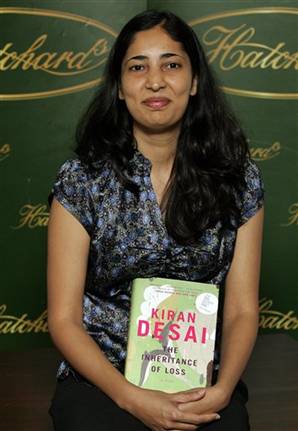 Kiran Desai's 'The Inheritance of Loss' is the book of intense thoughts, written with insight, compassion and uncompromising audacity to reveal the vulnerable self of an individual under desperate conditions of human life. The author has dealt with many global problems of today's contemporary world and modern society and thereby managed to stir reader's mind to look into the consequences of problems like globalization, emigration, multiculturalism, economic disparity and insurgency that have influenced the Indian mental attitude and deeply affected the very texture of Indian social system. This original work of her is a realistic novel in which she has vividly depicted the plight and dilemma of Indians living abroad who compromise their culture in the procurement of 'better life', 'high living standard' and 'modernity'.
'The Inheritance of Loss' opens with the story of teenage Indian orphan girl Sai who arrives her grandfather's isolated house 'Cho Oyu' at the foot of Mount Kanchenjunga in Kalimpong. Sai's grandfather Jemubhai Patel is an anglophile, retired judge living with his beloved dog mutt and his cook who manages the household. He is embittered by the experiences of his past life in Cambridge. Describing his isolation, the author writes, ‘He worked twelve hours at a stretch, late into the night, and in thus with drawing, he failed to make a courageous gesture outward at a critical moment and found, instead, that his pusillanimity and his loneliness had found, fertile soil. He retreated into a solitude that grew in weight day by day. The solitude became a habit, the habit became the man, and it crushed him into a shadow.’ She further explains his alienation as 'For entire days nobody spoke to him at all, his throat jammed with words unuttered, his throat and mind turned into blunt aching things…’ Sai, on the other hand, is in love with her mathematics tutor Gyan, a Nepali half-educated man who eventually draws back from her in the wake of ethical insurgency in the hills of Kalimpong. The judge’s cook has a son Biju, who is an emigrant in New York and skips one ill - paid job to another, spends his time moving from one gritty restaurant to another in the search of a green card. In the end, Biju arrived back in India but soon engulfed by local insurgency. All the characters in this novel share a common historical legacy and are victims of long subjection by western economic and cultural power.
The style of the novel is incredible. Kiran Desai's descriptive narration has made the novel enchanting, hilarious and pleasurable to read. Her comical way of description is impeccable and vivid depictions to display complex states of mind are meticulous. She has beautifully portrayed the pictures Kalimpong, its people, onset of monsoon in the Himalyas and Kanchenjunga. She describes, 'All day, the colors had been those of dusk, mist moving like a water creature across the great flanks of mountains possessed of clean shadows and depths. Briefly visible above the vapour, Kanchenjunga was a far peak whittled out of ice, gathering the last of the light, a plume of snow blown high by the storms as its summit.'
In another description of Kalimpong and its people, she writes, '…There was not a streetlight anywhere in Kalimpong, only as you passed they came up suddenly and disapproved immediately behind. The people who walked by us the black had neither torches nor lanterns...’she has adeptly drawn pictures of immigrant quarters, basement kitchens, gritty restaurants in New York and Visa counter at the US Embassy. Desai is equally superb in depicting abstract emotions and sentiments of her characters, as 'Jamubhai looked at the father, a barely educated man venturing where he should not be, and the love in Jemubhai's heart mingled with pity, the pity with shame. His father felt his own hand rise and cover his mouth: he had failed his son.'
Kiran Desai is truly a terrific writer as remarked by the noted writer Salman Rushdie and this irrefutable truth is clearly expressed in ‘The Inheritance of Loss', winner of the Man Booker Prize 2006.
Review "First Among Equals"
Posted On Monday, July 14, 2008 at at 14:00 by rk rishikesh sinha'First Among Equals' is a great political novel penned down by the great master story-teller Jeffery Archer who has beautifully spun his story by creating realistic characters and scenarios of English political life.
Pranati Saikia
The novel is my first Archer book and after reading it I find it undeniably refreshing. The author has used his comprehensive knowledge and past experience as a member of British Parliament in a perfect manner. The fast pace of the novel has provided the whole story a swift
moving flow without any dullness and unwanted interruption. The book is quiet readable and gripped my attention and retain my interest till the end of the story.
'First Among Equals' unravels the story of four main characters that are aspiring politicians and entered the House of Commons in the 1960's and played the game of power to achieve the ultimate goal 'The Office of PM'.
--Reymond Gould is the leeds grammer school boy who born above his father's butcher shop and married to a small town wife;
-- Simon Kerslake, is the President of the Oxford Union, a conservative supported by his doctor wife;
-- Andrew Fraser is the son of a conservative lord Provost but joined the labour party, a committed husband and a dedicated father;
-- Charles Seymour is the callous Tory landlord, the player of ruthless tricks to reach No. 10 Downing Street.
The novel has a very captivating storyline developed expertly around real events and human background. To avoid any kind of monotony due to lengthy depiction of parliamentary sessions, the author has also given same exhilarating and amusing episodes full of adventures and entertainment like discreet sexual affairs of Reymond, decent blackmailing and political conspiracy by ruthless Charles to win the race of power and the heart touching episode of Andrew and his five year old son Robert. All these episodes are irresistibly engrossing and enchanting too.
While reading 'First Among Equals', what impressed me most is Jeffery Archer's acute observation and perception of human beings and their tendencies on more fundamental level.
Though the novel has a political base but the background and the context is purely human. The author has skillfully drawn out positive qualities of shrewd politicians and wonderfully put forward their human sentiments and ethics. Generally politicians are disdained and castigated for their opportunism and cunningness but in the novel, the author has glorified them as he highlighted the perseverance and unbreakable grit of politicians while facing trials and tribulations of political world. By going through 'First Among Equals' one will surely recognize the tough life of politicians and acclaim their can-do attitude to be the survivors in the turbulent race of power. I would like to appreciate Jeffery Archer's advocacy for politicians in a optimistic way. Every description and portrayal is flawless and perfect. The novel is surely his political masterpiece.
Please SUBSCRIBE to the blog.

Indian Errors in America
Posted On Tuesday, May 27, 2008 at at 17:14 by rk rishikesh sinhaBy Rishikesh Sinha
Gopal whose identification in India is that he belongs to the small town called ‘the Paris of Madhya Pradesh’ and his family is in the hair-oil business, staying in America comes as a learning curve in his life.
His English is comical (I am hoping all is well and wealth…I am fine at my end. Hoping your end is fine too) and his Indian perspective about America, and about American people is bizarre (I think Americans are hating vegetarians…They are playing game which they are calling football in which they are beating each other without any mercies for no reason…I am feeling that they should do more beating each other then at least they are not beating rest of world), like many of the Indians have about America.
Especially the 4-letters (which shortens in its length with his long stay) that he wrote to his brother describing his feelings comes as a creamy froth in the whole novel. The letters written by him are as such that it will surely trickle a person with no funny bones. I would say the letters are gems in the whole book.
Leafing through the book, readers would find that they are discovering America not limited to the jovial but embarrassing experiences that any person of Indian DNA would have, but parallel to it they would be unfolding America in a different perspective. They do have problems; there are parts in the country which doesn’t look like America, “there is so much dirt” and “it is too poor”.
About the book ‘The Inscrutable Americans’ written by Anurag Mathur, I would share the same thought that the Times of India wrote about it, “There is no self-contempt or post-colonial anguish in it (‘The Inscrutable Americans’), instead there is a boisterous, if comical celebration of both India and America ”.
Please SUBSCRIBE to the blog.
Review: Mario Puzo's novel 'The Last Don'
Posted On Sunday, May 11, 2008 at at 10:41 by rk rishikesh sinhaTo create a crime free world for the future generations is the central theme of the  Mario Puzo’s novel ‘The Last Don’. Irony is that the urge of the mafia-free world comes from non other than the ‘Don’, whose hand is soaked in blood, killing that he perpetrated on his enemies and on his own family members! The novel ‘The Last Don’ by the writer Mario Puzo, if someone had read his previous novel ‘The Godfather’, is the pure sequel of the first. Readers will definitely enjoy ‘The Last Don’ as much they have liked ‘The Godfather’.
The plots of both the stories are same; the mafia world underlies ‘The Godfather’ and ‘The Last Don’. The law of omerta (silence) is maintained in both the world. There is a touch of Hollywood in both the novels. Despite its many similarities both the novels are completely divergent to each other. In ‘The Godfather’ where the Don Corleone aspiration to sync with the democratic world remains a chimera, in the ‘The Last Don’, Don Domencio Clerizuio is successful, but with a price.
The price involves killing of his grandchild Dante Clerizuio and Croccifixio De Lena, the son of Don’s nephew Joseph “Pippi” De Lena. The Don loved Pippi as much as he did his sons, for in addition to blood – Pippi being his dead sister’s son – he was the great general who had savagely conquered the Don’s enemy.
The story begins with the celebration of the christening of two infants (Dante Clerizuio and of Croccifixio De Lena). Here, the most powerful Mafia Family in America, Don Domencio Clerizuio planned to relinquish his power. And he had to do it with the most skillful benignity and with personal goodwill. He wants to see the coming generation to live in a world devoid of fear.
The Don declares, “Twenty, thirty years from now, we will disappear into the lawful world and enjoy our wealth without fear…We are rich, we no longer have to risk our lives to earn our daily bread”. However, he had a plan for the future; they would be serving others families at political front and would be meditating their quarrels, protect their money, for which they have to wet their beaks.
The declaration of the twenty, thirty years by the Don takes the reader to an engrossing path: the two infants becoming adults, Dante harbouring revenge of his father’s death, Croccifixio De Lena or Cross falling in love with a hot and sexy Hollywood babe. The story takes a sour turn when Dante murders Cross’s father Pippi. Consequently, Cross hatch a plot to kill Dante knowing that murdering Dante would risk his life, from the decree that would be authenticated by non other than the Don. But, he carries out the act meticulously and silenced Dante forever.
Till this, to the last page, readers would be thinking that the events that were unfolding were natural. But in the last page, while the Don was at his death bed, a secret is revealed that the revenge game was all part of the grand master plan dreamt by Don himself to be the part of the society.
“During the last five years he had seen Dante as the great danger to his master plan. Dante would resist the folding of Cluricuzio Family into society. And yet, what could he himself, the Don, do? Order the killing of his daughter’s son, his own grandson? Would Giogio, Vincent, and Petie (Don’s son) obey such an order? And if they did, would they think him some kind monster? Would they fear him more than they loved him? …But when Pippi De Lena was killed, the die was cast. The Don immediately knew the truth of the matter, investigated Dante’s relationship with Losey (cop who supported Dante to kill Pippi) and made his judgment….And then to forewarn Cross, told him the story of the Santadio War (where Cross’s father Pippi murdered Dante father).”
While reading the novel one finds that the philosophies of life apply similar to the mafia world: 1) “What’s past is past. Never go back Not for excuses. Not for justification, not for happiness. You are what you are, the world is what it is.” 2) “People must earn a living, that comes first.” 3) “Love is not a reliable emotion no matter how deep. Love does not ensure gratitude, does not ensure obedience, does not provide harmony is so difficult a world. To inspire true love, one also had to be feared. Love alone was contemptible, it was nothing if it did not also include trust and obedience. What good was love to him if it did not acknowledge his rule?” 4 ) “Be aware. The world is what it is. And you are what you are.”
I would say Mario Puzo’s novel is excellent, gripping and engaging in nature. You will never miss something that is missing from the beginning to the end. The writer has been able to keep his readers on their toes. Unless, they have read “The Godfather”.
Next Book Review: The Inscrutable Americans
V.S Naipual's novel Miguel Street
Posted On Wednesday, April 16, 2008 at at 11:45 by rk rishikesh sinhaWe all have our beautiful childhood days; days which were the loveliest and 
The V.S Naipual’s 1959 novel Miguel Street consists of seventeen chapters and 166 pages. Each chapter is devoted to one character who had been in relation with the author. Naipual has brilliantly described his days in Miguel Street, South Africa.
While reading the book, one could feel the air that blows in the Miguel Street. However, they will also appreciate the sharp observation of the events and that of the person that the author paints.
Beginning with Bogart, about whom the author has ‘the most bored men’ views, each chapter is devoted to a men and women living in the Miguel Street. There is Popo, a carpenter, and a very interesting person, living in the Miguel Street. Whenever the author ask him, ‘What you making, Mr Popo?’ he has the often repeated answer, ‘Ha, boy! That’s the question. I making the thing without the name’.
In similar manner, the author goes to describe Elias, the cleanest boy in the street. ‘He bathed twice a day and scrubbed his teeth twice a day. He did all his standing up at the tap in front of the house. He swept the house every morning before going to school. He was the opposite of his father. His father was short and fat and dirty. He was tall and thin and clean. His father drank and swore. He never drank and no one ever heard him use a bad word.’ Unfortunately, Elias good manners appeared as problems for the author since his mother used to say to him, ‘Why you don’t take after Elias? I really don’t know what sort of son God give me, you hear.’ Very funny!
Going further, there is Man-man in Miguel Street. Everybody in the street said that he was mad but the writer wasn’t sure of it. According to the author, there were ‘many people much madder than Man-man ever was’. He had a curious habit. ‘He went up for every election, city council or legislative council, and then he stuck posters everywhere in the district. These posters were well printed. They just had the word ‘Vote’ and below that, Man-man’s picture. However, the funniest aspect of his life was that at every election he got exactly three votes!
And there is B. Wordsworth, a poet who goes around in the street selling poetry. The author was very impressed by his poetry and of his personality. Well, B. Wordsworth wrote only one line in one month: ‘The past is deep’! He says, ‘I hope to distill the experience of a whole month into that single line of poetry. So, in twenty-two years, I shall have written a poem that will sing to all humanity’! Very witty!
The novel doesn’t end with the description of Bogart, Popo, Elias, Man-man and B. Wordsworth. There are many enchanting, witty and humourous characters. While you read you will observe the writing style followed by V.S Naipual. The sentences are short; the names of the characters are short and very funny.
One more thing that I have observed reading the novel almost every man beat their wife and in some stories wife beating their husband. Frankly speaking leaving out some occasional witty descriptions, there is nothing in the novel that pushes you to read it in one go. It doesn't possess the captivating power of a novel. I found it ordinary and appears to me as insipid to the taste of the most of the readers but author's die hard fans might like it. Nevertheless, the clarity and simplicity of Naipaul's writing can grip the interest of the readers and push them to finish it.
Next review: Five Point Someone by Chetan Bhagat
Please SUBSCRIBE to the blog.
Review: J.M Coetzee's novel Disgrace
Posted On Wednesday, April 09, 2008 at at 08:09 by PRANATIY SAIKIAJ. M Coetzee's novel 'Disgrace' deals with human flaws and  frailties. It depicts the vivid picture of social and political scenario that prevails in the post-apartheid South Africa. The novel also highlights subtle nuances of human emotions and relationships, governed by differences, discrimination and disparities based on gender, generation and race.
'Disgrace' as the name suggests stigma, degradation and humiliation, the novel unfolds a pathetic story about a middle aged professor who brings disgrace on himself and had to suffer humiliation by his indiscreet involvement with one of his students.
David Lurie, the main character of the novel, is a 52 year old professor. He earns his living at the Cape Technical University. Though he is a middle aged man yet he is strongly passionate about sex and women. He has been divorced twice and strives hard to satisfy his sexual needs. He is also unhappy with his professional life. Once he was a professor of modern languages but with the closing of Classics and Modern Languages, he is demoted to the post of adjunct professor.
David visits a prostitute, Soraya who gratify his sexual needs. Under certain circumstances, Soraya quits her profession and discards him. Consequently, he feels gloomy and perplexed without his rendezvous with Soraya. But his life takes a drastic turn when one evening while returning home, he meets Melanie Issacs, one of his students from his Romantics Course. He gets 'mildly smitten' with her striking beauty. Soon they develop an affair and during their intimacy he makes love to her.
But the problem arises when the young lover of the girl comes to know about their intimacy. Forced by her family and friend, Melanie files a complain against David of sexual harassment. However, David refuses to apologize and take no step to save defend himself. Finally he resigns from his post and visits his daughter Lucy's farm in Eastern Cape.
Lucy makes her living from kennels and selling flowers and vegetables she grows. She has an African Assistant Petrus, who is also her co-proprietor, to help her in gardening and looking after her dogs.
Then one day three African attackers loot them and rape Lucy, and kill her dogs. Consequently their life turns into hell. Lucy gets alienated with her normal life and lose all her vigour. By seeing her desperate and disheartening condition, David insists her to sell the farm. Nevertheless, Lucy insists to stays on and continue her life there.
This creates disharmony and unrest between father and daughter. Lucy says to David, "...what if that is the price one has to pay for staying on. Perhaps that is how they look at it; perhaps that is how I should look at it too. They see themselves as debt collectors, tax collectors. Why should I be allowed to live here without paying? Perhaps that is what they tell themselves?" Ultimately, David persuades himself and accepts Lucy's decision to stay on.
Disgrace wins the 1999 Booker Prize and the way Coetzee has treated many subtle issues in the novel, has made the novel worthy of it. The book is gripping and inspiring from the first go. The most striking feature of the Coetzee's creation 'Disgrace' is the intensity with which the writer presents the influence of one's deeds on one's life. Deeds follows one's destiny is what clearly depicted in the novel.
Next Book Review: Miguel Street by V.S Naipaul
Book Reviewed:
The Godfather by Mario Puzo
Train to Pakistan by Khushwant Singh
A Journey to Lhasa and Central Tibet by Sarat Chnadra Das
Please subscribe to the blog.
Review: Mario Puzo's Novel The Godfather
Posted On Friday, April 04, 2008 at at 09:12 by rk rishikesh sinha Mario Puzo's book "The Godfather" gives an insight about the world of mafia in America in the early 40's and in the 50's. The book is about a Don and his beliefs, about his struggle to establish his empire despite many obstacles that come in his way.
Don Corleone is a real 'Don' of the mafia whose hands are soaked in blood. But there is another picture of him that makes him the "Godfather" of many lives. Those who were benefited by Don's benevolent work owed their good fortune to him.
What is a mafia? Like any other organ of the society, mafia is also a organ which cements its power by originating a law but this is the law of silence, the omerta.
Who are the mafia men? Mario Puzo's novel "The Godfather" describes:
The novel gets its pace and tone right from the opening sentences of the chapter 1 with Amerigo Bonasera sitting in New York Criminal Court Number 3 and waiting for justice filled with vengeance on the men who had so cruelly hurt his daughter, who had tried to dishonour her. But hell break loose when Amerigo Bonasera who all his years in America had trusted in law and order wasn't satisfied with the pronouncement of the order of the judge. And he, like many others who didn't get justice, decides "For justice we must go on our knees to Don Corleone."
They were those rarities, men who had refused to accept the rule of organised society, men who refused the dominion of other men. There was no force, no mortal man who could bend them to their will unless they wished it. They were men who guarded their free will with wiles and murder. Their wills could be subverted only by death. Or the utmost reasonableness.
Like Amerigo Bonasera, there were people like Johnny Fontane and Nazorine for whom meeting with a man who has the power, the wisdom, came as a necessary. The man is the Godfather. Don Corleone. He who takes others problems as his own.
The next moment the plot of the story goes to Don Corleone's daughter Constanzia Corleone wedding venue in Long Island. There Don meet with Amerigo Bonasera, Johnny Fontane and Nazorine and with a stoke of genius solve their problems.
But something that would interest everybody, and I was not the exception, was to understand Don, his philosophies, his way of thinking from the conversation that took place between him and Amerigo Bonasera.
Reacting on the plea by Amerigo Bonasera to murder the two boys who had disfigured his affectionate daughter, the Don held up his hand in rage and blurt out, "No. Don't speak. You found America a paradise. You had a good trade, you made a good living, you thought the world a harmless place where you could take your pleasures as you willed. You never armed yourself with true friends. After all, the police guarded you, there were courts of law, you and yours could come to no harm. You did not need Don Corleone. Very well. ....I am not that sort of person who thrusts his friendship on those who do not value it - on those who think me of little account. However, Amerigo Bonasera wish was at last granted by the Don.
In the wedding of the Don's daughter, all the important persons of the Don's empire is introduced one after another. In his empire his three sons Sonny Corleone, Frederico Corleone, alias Fred or Fredo and Michael Corleone are also included.
After the wedding, the story goes on along with many characters. Readers come to  know about the Don, his life, how his image got transformed into the stature of a kindhearted Godfather who helped many. He is adorned with the characteristic of a statesman, who sees future, who understand the interdependency of national and international politics and its affect on its empire. Owing to his farsightedness and political insightedness, his men and women didn't suffer when in US Great Depression period striked.
The story takes a chilling turn when the Don is shot, got critically injured and was unable to deliver his duties. Following with it, events started unfurling so fast in the mafia world that Michael had to go hiding in Sicily after murdering one corrupt Police Captain and Sollozzo, the man who was behind the attack on Don's life. The Corleone family had to go to war against their rival families.
During the same period Don's first son Sonny Corleone who was very much active in the family business and who had the capability to run the mafia business, is murdered. As time proceeds, the Don gets well and he relinquishes his duties allowing Michael (Don's third son) to takeover.
Well, the transition was not simple. It was interspersed with the law of silence, the omerta of many enemies and of family's member. Michael kills Tessio, the friend and strong confidante of his father and his brother-in-law as they planned treachery against them.
Mario Puzo's novel The Godfather is fantastic, gripping and very much insightful. It has got all the elements that you would love to read again and again. It is not mere a story, it is a story of a time period woven around the mafia.
Interested! Read more
Train to Pakistan by Khushwant Singh
Next review: Disgrace by J. M. Coetzee
Please subscribe to the blog.
Khushwant Singh's Novel Train to Pakistan Review
Posted On Thursday, March 20, 2008 at at 20:46 by rk rishikesh sinhaWe all know the tragic events that came with the Independence of India in 1947. We have heard from nowhere that train full of corpse were exchanged between India and Pakistan. Noted writer and journalist Khushwant Singh's brilliant novel 'Train to Pakistan' is about the story that built on the backdrop of Indo-Pak partition.
The novel, though a fiction, has incisively treated the India of 1947. It tells how people of different faith in the village called Mano Majra took the tragic event of partition? A partition that was done in the line of religion. The novel catches Mano Majra in its totality. It's geography, architecture, religion, and peoples' live has been described so vividly and accurately that often the village comes crystal clear in our eyes.
While reading the novel 'Train to Pakistan', like myself who has been smitten by the Khushwant Singh's first work, you would surely be full of adulation with the precision at which he narrated and build the relationship that the village Mano Majra had with the nearby railway station, and with the plying of trains between India and Pakistan.
Not enough, another aspect of the novel that would surely mesmerize you and make you feel as you are moving with the story comes with the mentioning of monsoon at the end of the plot. It invigorates life to the whole story making it very real and near to our heart.
The story takes pace and things started changing in the tiny village when dacoits kill the moneylender Lala Ram Lal and tossed a part of the looted material onto Juggat Singh's (Juggia) house. Police arrest Juggat Singh, a registered budmash in the book of law enforcers, along with social worker Iqbal Singh on the direction of the Sub-Inspector.
The tranquilizing peace of the tiny village, love and commotion among Hindu, muslims and sikhs get all shattered when one day a 'ghost train' arrived from Pakistan full of dead bodies. However, the arrival of the another train with the same fate poisoned the whole weather of the village.
Nooron, oblivious of the changed weather, her father Imam Baksh and the muslim committee who had been living in the Manoo Majra for centuries were truck loaded to refugee camp and later to Pakistan. If something was left behind it was only the love of Juggat Singh and Nooron, Hukum Singh's remorse of letting a girl of her daughter's age with whom he had a luscious relationship to Pakistan.
Khushwant Singh's book 'Train to Pakistan', I found very much engaging, entertaining and so to put in the words of Arthur Lall, Former Ambassador and Permanent Representative from India to the United Nations: The book continues to be the one that any reader of fiction would greatly enjoy. It deserves to be recognised as a classic.
Next Book Review: Mario Puzo's The Godfather
Related Book Reviews:
Incredible India Cuisines
A Journey to Lhasa and Central Tibet
Please subscribe to the blog.
Book Review : Vikram Sarabhai - A Life
Posted On Sunday, September 30, 2007 at at 07:18 by rk rishikesh sinhaBy Anurabh Sinha, Guest Writer
The biography is titled 'Vikram Sarabhai~a life~' authored by Amrita Shah. This biography by Amrita Shah delves deep into the real character behind the name Vikram Sarabhai. The biography starts by taking us into Vikram Sarabhai’s childhood. Born with a silver spoon in his mouth, he had a princely childhood. His doting parents ensured that he was reared up in the best possible fashion.
As a toddler, Vikram turned out to be noticeably energetic and showed flashes of his brilliance during the growing up years. His love affair with Science began in his school days when he worked in his specially constructed ‘home-labs’. With the passage of time, the interest became a full fledged passion.
Coming from a highly renowned family made things pretty easy for him as he traveled world wide meeting some of the greatest scientific minds of his time. The book has some very engaging episodes of his encounters with the likes of Millikan, Raman and Bhabha.
The author very successfully unravels different facets of the great man’s personality. To his children, he was the most doting father they could have had, often taking on the mantle of a ‘single parent’ to help his wife pursue her passion for dance. On the family front though, all was not well.
There was always the shadow of the ‘other woman’ looming large. He was quintessentially a man who could charm people and get the best out of them. Man management was something that came naturally to him, whether it was working with a grass root level worker or with the top brass.
A philanthropist to the core, Sarabhai was instrumental in the setting up of some of the best institutes in the country to date, including the IIM Ahmedabad. This was his humble contribution towards the greater cause of nation building. He was someone who had his own views on serious issues like nuclear technology and space exploration.
Counted amongst the greatest scientists of his time, these were also the issues that were close to his heart. Towards the later stages of his life, he had a tough time handling men with political inclinations.
The author has done tremendous amount of research in coming up with this biography making it a very interesting read. Loads of amusing incidents and anecdotes are scattered throughout the book. This apart, there is also a rare collection of photographs tracing the life of Sarabhai from a toddler to the Vikram Sarabhai known to us. Once you have started with the book, you won’t feel like putting it down.
Incredible India Cuisine Review by Pushpesh Pant
Posted On Friday, July 20, 2007 at at 22:30 by rk rishikesh sinhaNEW DELHI, INDIA Incredible India Cuisines
Author : Pushpesh Pant
Publisher : Wisdom Tree
Darya Ganj, New Delhi-110002
The present volume, one of ten ‘Incredible India’ series, offers a novel approach to the cuisines of one of the cradle of the ancient civilization, India. The book is in the semblance with other related literature which describes the rituals and traditions; sculptures and paintings; dance, music and theatre; handicrafts, fairs and festivals; monuments and manuscripts, of a country.
Food embodies the spirit of a civilization and is as integral a part of a nation’s identity as are its monuments and art forms. And the book written by Pushpesh Pant has been successful driving the point – Food is a nation’s identity, the spirit of civilization.
Incredible India Cuisines neatly stitches the mouth-watering, culture-defining dishes from northern part Kashimir, to the southern part Kerala; and from Bengal to Rajasthan. Pushpesh Pant has taken the route of food to describe the cultural, political, historical hotspots of India.
One will find cuisines of Awadh, Hyderabad, Goa and coastline, Punjab and Tamil Nadu, not to forget Delhi being mentioned in the book.
The book gives an interesting reading. The procedural method of recipes and its related caricature has being mentioned superbly and not like other books of this genre do, but this has been catered in the context of the history of the place, of course keeping an eye on the very purpose of the book that is cuisine and not getting lost in its history.
From the Introduction mentioning the basic tenets of India’s culinary philosophy – the concept of satvik, rajasik and tamasik, the book next goes to touch the factors and changes that influenced the evolution of distinctive Indian cuisine. Later the book goes to describe major culinary regions of India.
The book stitches Kashmir’s Ghushtaba, Nadr Yakkmi recipes, Punjab’s Murg Malaai Kebab, Dal Makhani, recipes Barrah Kebab and Berhvin Poori of Delhi, Rajasthan’s Kandey ki Sabzi and Bharwan Gatte, Awadh’s Murg Mussallam and Lauki Mussallam; Goa Fish Curry and Chicken Xacuti of Goa and Coastline, Kerala’s Aviyal and Pepper Prawns.
The culinary inheritance from Tamil Nadu with Sambar and Vendakai Masala Pachchadi, to the Baghare Baingan and Hyderabadi Dum ki Biryani of Hyderabad, to the Alu Potol and Doi Machh of Bengal have found place in the book.
The last and the fianl chapter ‘Fusion During the Raj’ of the book is the one, which keeps it away from the other recipe books flooding the market. This chapter encapsulates the culinary innovations that took place when the Britishers came to India, married to local women and made India their home. And the cuisine evolved from the marriage of local cuisine and the British cuisine, which later came to known as Anglo-Indian cuisine has been given space.
The book ends with many of the ‘brand’ dishes of India from Khubani Ka Meetha, found-in-nook-and-cranny Samosa, to the popular dishes like Shahi Tukhra, Kesari Kheer, Baqarkhani Roti, Lachha Parantha, Amritsari Kulcha, Makkai ki Roti, Makhane ka Raita to Khichari.
Among many historical facts, the present day midday meal in school Khichari was once served to Salim, son of Akbar, after he returned from a victorious campaign in Deccan that interested me and made me to ponder.
The book is not for those who are recipe acquirers. It has a less number of recipes. But this comes for those who are really interested to know India with food. It is sure the book would give a nice reading to both national and international reader alike.
A Peep into the 100 years back Tibet
Posted On Thursday, July 12, 2007 at at 00:46 by rk rishikesh sinha
There are times when we all talk about the past, the past that is hundred years back; and without any thought process involved we all start dreaming…and we dream. And what we all find in our dreamy state of our reverie, all those gadgets and the lifestyle that are around us getting vanished; we all residing in a peaceful scattered village hamlet. Where our needs are few and far between.
That’s imagination is what you will find in the book A Journey to Lhasa and Central Tibet written by Sarat Chnadra Das, published by Rupa and Co., and edited by W.W Rockhill. 
In the book you will find the customs, culture and beliefs of the Tibetians people. Besides it, you will definitely get engrossed with the graphic descriptions of the vegetation, religion and the architecture of the area where the author has traveled. It is a different story that he worked as a spy for the government of British India. That was not disclosed when the book was first published.
I will not go deep into the book since it is very tough to encapsulate the whole book in go. There are far too many interesting subjects covered in this book for me to mention them all here; but here are some “picks” from it that has really touched me or say surprised me.
Discussing the virtues of polyandry versus polygamy versus monogamy he writes: “…..she stared at me with undisguised astonishment. “One wife with one husband!” she explained. “Don’t you think we Tibetans women are better off ” The Indian woman has but a portion of her husband’s affection and property, but in Tibet the housewife is the real lady of all the joint earnings and inheritance of all the brothers…”
On marriage he writes: “In Tibet, there are no caste restrictions with regard to marriage in India. The rich may bestow their daughters on the poor; the daughter of a poor man may become the bride of the proudest noble of the country”.  While describing the conditions of employment of an express courier between Lhasa and China, he writes: “They are required to subsist daily on five hen’s eggs, five cups of plain tea, a pound of cornflour, half a pound of rice and a quarter of lean meat. They are forbidden to take much salt, and are strictly forbidden to eat onions, garlic, red pepper, butter or milk. At midnight they are allowed to sleep in a sitting posture for three hours, after which they are awakened by the keeper of the stage-house…The courier is allowed to change his dress once a week”.
And here is the last ‘seed’ I am taking since it will change your whole perception about the world, and the small world where we are living. The world is not what is in and around you but somewhere else, far away from your wild imagination and thought process.
Here is goes, the writer writes: The custom of several brothers making one woman their common wife, to keep the ancestral property entire and undivided, ……is at this day extensively practised. ………The wife is claimed by the younger brothers as their wife only so long as they continue to live with the eldest one. ………It is not unusual for a father or uncle to live with his son’s or nephew wife, and even in high life a father makes himself a partner rights over his son’s wife.
The book is full of many unexpected U – turn surprises sometimes curvy and sometimes very straight tangentially.
PUNJAB
